The model starts by considering a mechanism for gravity
The model is then built around that mechanism


Physics Built From First Principles
Without The Need To Use Quantum Fields
The model starts by considering a mechanism for gravity
The model is then built around that mechanism
The reason for starting with gravity, is that there might be only a few mechanisms that can produce gravity*
If that is the case, then the model's chosen mechanism for gravity, could be the correct mechanism - link to the model's discussion on gravity
The mathematics for the model is a physics engine that models the behaviour of a strand shaped particle
The model discusses gravity, mass, electric charge, electric fields, subatomic particles - and the atom without the need to use quantum fields

If you would like to help publicise the model for discussion,
please feel free to inform other people about the model
Thank you
Bob Pike
(string for search engines "aphysicsmodel" "thesimplemodel" "thesimpleuniverse")
The concept of a quantum field is the basis for modern physics
Modern physics uses quantum fields to model the subatomic particles, and evidence for quantum fields is given by the atom and the double-slit experiment
However, quantum field theory is yet to include gravity
In contrast to modern physics, this model uses a strand shaped particle to model the subatomic particles
These subatomic particles are then used to model the atom, the double-slit experiment, and gravity
The strand shaped particle has a shape, and a size, and a surface, a surface which can bend and stretch, and the strand shaped particle moves at a single constant speed against a static universal reference frame, in three dimensional space
In the model, the subatomic particles are built using a physics engine that processes the behaviour of the strand shaped particle
Please note that these discussions have been produced without having the physics engine
In addition to the atom, the double-slit experiment, and gravity, the model also includes building the atomic nuclei for the atoms
The stable atomic nuclei that have been modelled, match against the experimental stable isotopes, with the number of stable isotopes for each element, from hydrogen through to iron, being
| 2 Hydrogen | 2 Helium | |||||||||||||
| 2 Lithium | 1 Beryllium | 2 Boron | 2 Carbon | 2 Nitrogen | 3 Oxygen | 2 Chlorine | 3 Argon | |||||||
| 1 Sodium | 3 Magnesium | 1 Aluminium | 3 Silicon | 1 Phosphorus | 4 Sulphur | 1 Fluorine | 3 Neon | |||||||
| 2 Potassium | 3 Calcium | |||||||||||||
| 1 Scandium | 5 Titanium | 1 Vanadium | 3 Chromium | 1 Manganese | 4 Iron | |||||||||
In addition, many of the unstable isotopes from hydrogen through to iron, have been modelled, and they match against their experimental decay sequences (although, a couple of the decay sequences were not able to be absolutely predicted by the model)
In total, over two hundred atomic nuclear isotopes have been modelled, and they all appear to match against their experimental counterparts
Could this number of agreements by the model to experiment, a number that would appear to be beyond the realm of coincidence, and by a model that is based entirely on particles
Counter the modern physics suggestion that quantum fields are real
Also, note the following remarkable statement
Using only the shape of a strand, it is possible to predict which atomic nuclei are stable, and for the unstable nuclei, predict their decay sequences
Think about that for a moment
For reference, here is a plot of the experimentally determined atomic nuclear stability and decay

Image produced by Wikimedia user Admiral sayony
Link to the model's Atomic Nuclei Builder animation - an animation that is interactive and let's you build the model's atomic nuclei
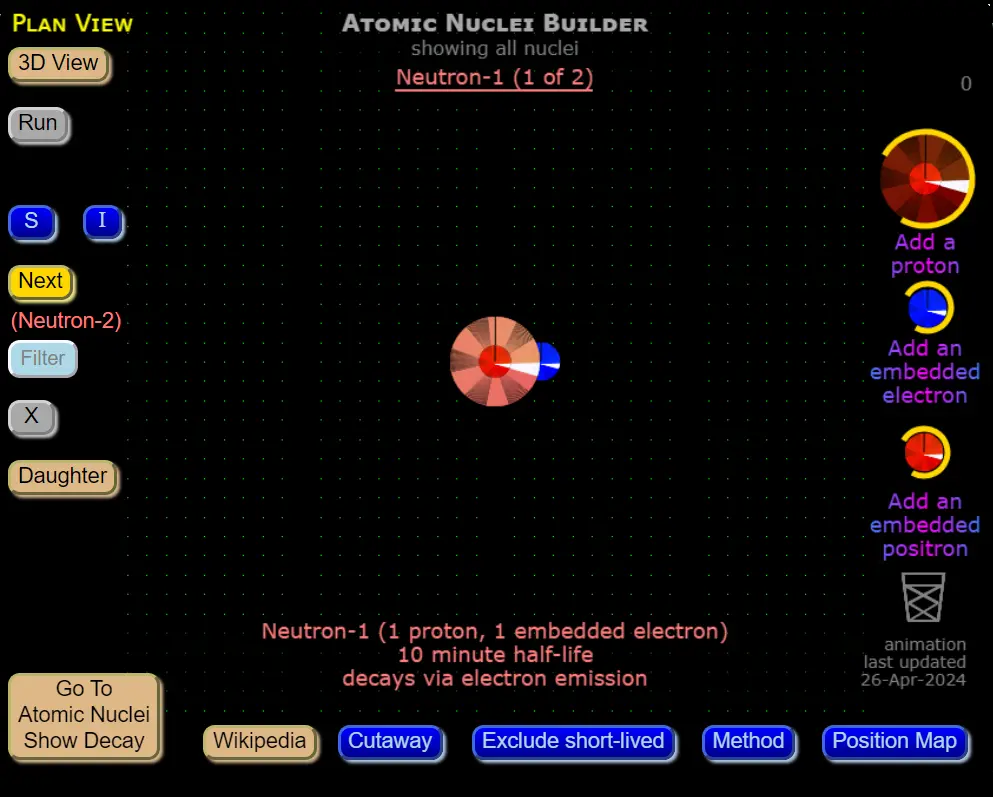
Please note, in the model, atomic nuclei have a flat structure
Which is different to the structure that is often used to depict an atomic nucleus

Image produced by Wikipedia user Marekich
For reference, here is a computer visualisation of a quantum gluon field, that in the Standard Model of particle physics, binds protons and neutrons together in an atomic nucleus

Image produced by James Biddle, Josh Charvetto, Waseem Kamleh, Derek Leinweber, Helen Piercy, Ethan Puckridge, Finn Stokes, Ross D. Young, James Zanott, in their scientific paper (2019) Publicising Lattice Field Theory Through Visualisation
For reference, modern physics uses the Standard Model's Lagrangian equation to generate the quantum field behaviour of the subatomic particles

Image produced by Chen Ning Yang, Robert Mills, Chien-Shiung Wu, Sheldon Glashow, Steven Weinberg, Abdus Salam Wikimedia Commons Index Id 109673501
A Physics Model The Simple Model The Simple Universe
